

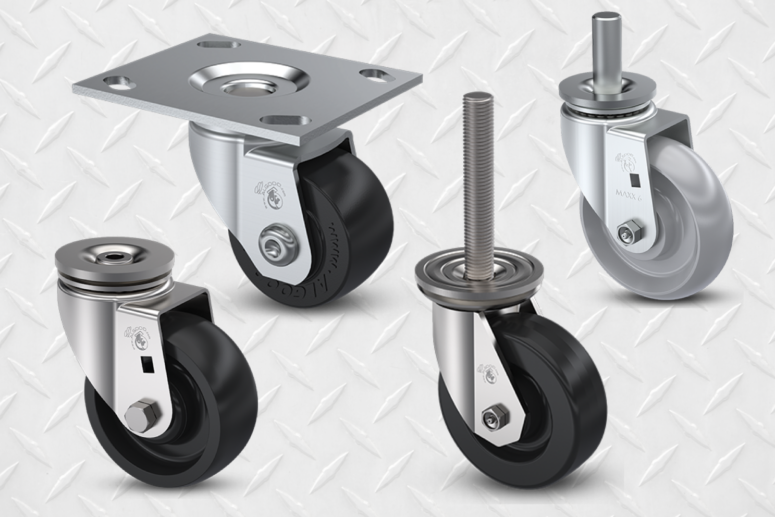
A caster may be expertly engineered, but if the mounting method is not suited to the load, operating environment, or equipment frame, overall performance will be compromised. The mounting system plays a critical role in transferring forces from the equipment into the caster, maintaining proper alignment, and ensuring long-term stability. It directly influences tracking accuracy, swivel performance, load distribution, and the caster’s ability to hold position reliably throughout its service life.
At Algood, we view caster mounting as an integral part of the overall mobility solution, not just an attachment method. Like the caster itself, the mounting choice should be driven by practical engineering considerations. The objective is to provide a secure connection that keeps the caster stable, properly supports the load, and allows equipment to move safely, smoothly, and predictably. The “right” mounting method is the one that fits the equipment structure, withstands the operating environment, and delivers the required performance with the fewest compromises over the life of the application.
In this issue of CasterU, we provide a primer on common caster mounting types, including where each is best suited and how it can impact caster performance.
Bolt Holes – A mounting pattern where fasteners pass through holes in the caster mounting surface and into the equipment frame.
Best for: Equipment with a flat mounting surface and accessible underside, and applications where the caster needs a firm, permanent connection.
Performance impact: Bolt-hole mounting can deliver excellent stability when the fasteners are correctly sized and tightened. It resists loosening and helps maintain alignment, which supports smoother swivelling and better tracking. In demanding environments, bolt holes also make it easier to service and re-torque hardware during maintenance.
Top Plates – A flat plate at the top of the caster that bolts to the equipment using a bolt pattern.
Best for: Carts, platform trucks, racks, fixtures, and equipment where a broad mounting footprint improves stability.
Performance impact: Top plates distribute load across a larger area of the frame, reducing localized stress. That often translates into a more stable ride, less frame flex at the mounting point, and improved control. If the equipment is subjected to side loads or frequent starting and stopping, a plate mount can help maintain caster alignment and reduce wobble.
Threaded Stems – A threaded post that screws into a matching threaded socket or insert in the equipment.
Best for: Lighter-duty equipment, appliances, displays, and units where a clean, compact mount is preferred.
Performance impact: Threaded stems can provide a secure connection when properly engaged and tightened. Performance depends heavily on thread engagement and the integrity of the receiving socket. If the stem is not fully seated or the threads wear, the caster can loosen and introduce vibration or misalignment, which affects rolling efficiency and steering feel.
Round Stems – A smooth, round post that inserts into a receiving tube or socket, typically held with a retaining method.
Best for: Equipment frames built with tubular legs, and applications where quick installation or replacement is useful.
Performance impact: Round stems can perform very well when the socket fit is correct. A tight fit supports stable tracking and reduces chatter. A loose fit can allow the caster to rotate or shift under load, which affects control and can accelerate wear at the connection point.
Square Stems – A stem with a square profile that fits into a square receiver in the equipment leg.
Best for: Tubular frames where anti-rotation matters, or where the equipment design benefits from a keyed, non-round interface.
Performance impact: Square stems help resist rotation inside the leg, which can improve steering consistency and reduce unwanted movement at the mount. Because the fit is more directional, it can also help keep casters aligned, especially on equipment that gets pushed hard or frequently changes direction.
Expandable Stems – A stem that expands inside the equipment leg when tightened, creating a friction-based grip.
Best for: Tubular legs where drilling is undesirable and fast installation is important, such as light-to-medium equipment, displays, or certain carts and fixtures.
Performance impact: When properly sized to the inside diameter of the leg and correctly tightened, expandable stems can provide a strong hold. Performance depends on maintaining that grip over time. In vibration-heavy use or where loads shift frequently, periodic checks help ensure the mount remains tight and the caster stays aligned.
Hex/Keyway Stems – A stem designed with a hex or keyed geometry that interfaces with a matching receiver to prevent rotation.
Best for: Equipment where torque and side loads could cause a standard stem to slip, or where maintaining consistent caster orientation matters.
Performance impact: These mounts are designed to improve control by resisting rotation at the connection. That typically supports more predictable steering and reduces the chance of the caster “walking” in its mount. For operators, this often feels like steadier tracking and less drift.
Cross Drilled Stems – A stem with a cross hole that allows a pin or fastener to pass through, mechanically locking the stem in place.
Best for: Applications where you want a positive, mechanical retention method rather than friction alone, and where equipment sees movement, shock, or repeated directional changes.
Performance impact: Cross drilled stems can increase security and reduce the risk of pull-out or loosening. Because the connection is mechanically locked, alignment and stability can stay more consistent over the life of the caster, supporting smoother rolling and more reliable control.
Specialty Stems, Mounts and Plates – Custom or non-standard mounting solutions designed around specific equipment geometry, load paths, or environmental requirements.
Best for: Unique equipment frames, retrofits, constrained clearances, unusual load distributions, or applications where off-the-shelf mounting introduces compromises.
Performance impact: Specialty mounts are often where performance gains are won or lost. The right custom mount can improve load distribution, increase stability, solve clearance problems, or support a specific way the equipment is used. When a mount is designed to match real conditions, the caster performs more closely to its intended capability, and the equipment is easier to move and control.
Important Installation Considerations
For bolt-hole and stem-mounted casters, the equipment mounting structure must be designed so that the caster’s top washer, round plate, or mounting shoulder is always firmly seated against the mounting surface. There shouldn’t be any gap between the mounting surface and the caster’s load-bearing mounting interface.
A gap can transfer loads through the stem alone rather than through the intended mounting surface. This leads to stem bending under eccentric loading, significantly increasing stress concentrations and reducing the caster’s load-carrying capacity. The result may be fatigue failure, assembly loosening, or premature caster failure.
Proper installation ensures that loads are transferred through the caster’s designed load path, maximizing strength, stability, and service life.
Choosing the right mount
If you want the simplest rule: choose the mounting method that keeps the caster firmly aligned under your real operating loads and conditions. From there, it becomes an exercise in fit, serviceability, and practicality.
This is where Algood’s approach comes into focus. We are customer-centred, design-focused, and committed to building solutions for real-world applications. Rather than forcing a one-size-fits-all solution, we focus on selecting the mounting method that best supports stability, durability, and reliable caster performance throughout the application’s lifetime.
For help choosing the right mounting type for your application, contact your local Algood representative or a member of our customer service team.